MAGAZINE · Jang Sunday Magazine · 6 September 2026 · by Aleena Wahid, Islamabad
Wings of the Homeland
وطن کے شہ پر
Sixty-one years after the September War, Pakistan's largest Urdu daily devoted its Defence Day supplement to the pilots of 1965. Sajad Haider (Sajjad Haider) is named alongside M. M. Alam as one of the two men who changed the course of the air war.
The hero of Pathankot
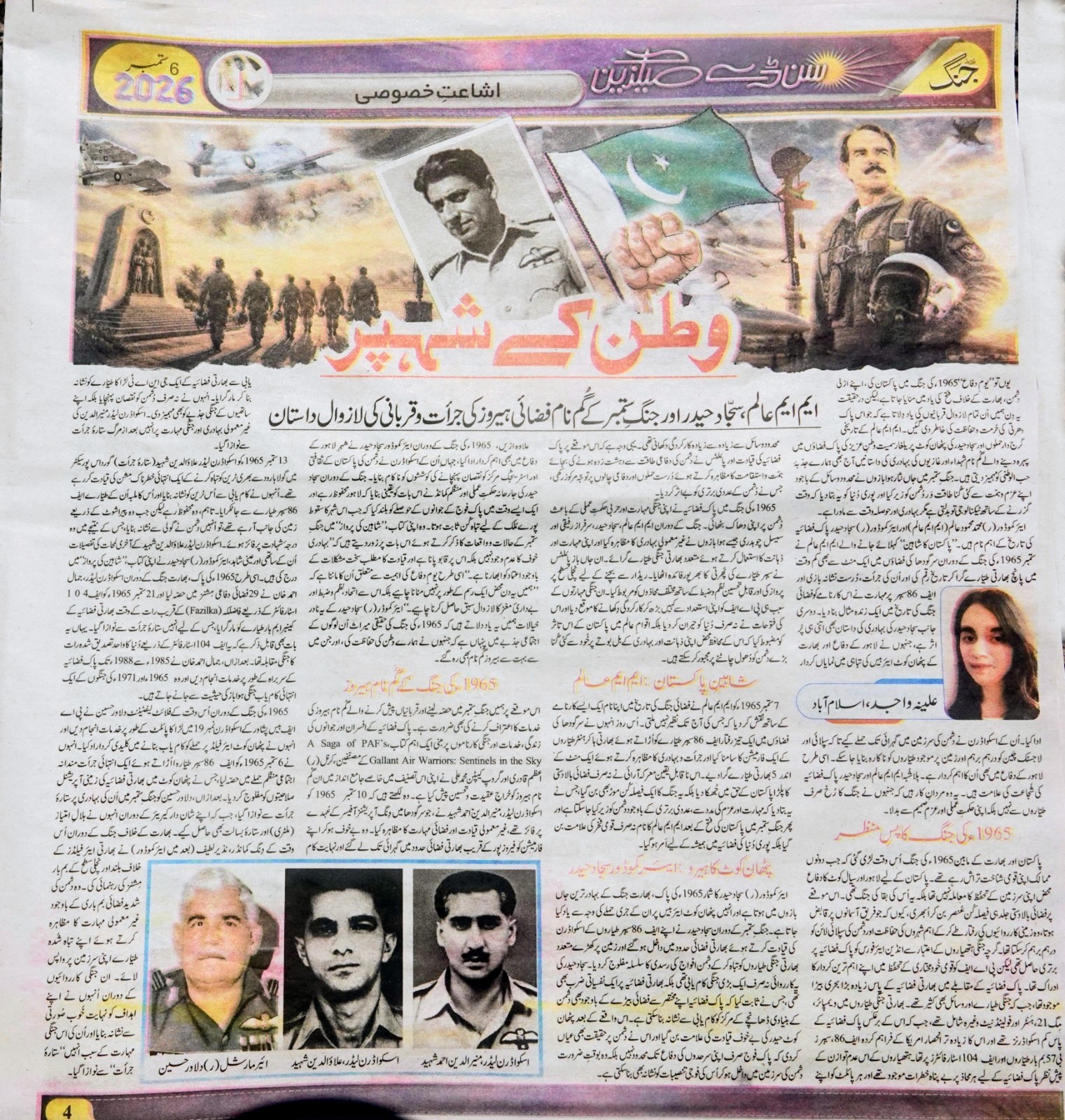
On 6 September 1965, Sajad Haider led No. 19 Squadron in the F-86 Sabre strike on Pathankot airbase, destroying Indian aircraft on the ground and cutting into the supply and logistics behind the front. The article makes the point that mattered most at the time. Pakistan was not only holding Lahore and Sialkot. It was reaching into Indian territory and hitting military installations there.
For that raid he was awarded the Sitara-e-Jurat. He later received the Hilal-e-Imtiaz (Military) and the Sitara-e-Basalat. His account of the war appears in his book, Flight of the Falcon: Demolishing Myths of the Indo-Pak Wars 1965 and 1971.
Pakistan's falcon
The companion profile covers M. M. Alam and the engagement of 7 September 1965 over Sargodha, flying the same F-86 Sabre. The article presents the two men as a pair. One demonstrated that the Pakistan Air Force could strike first and strike deep. The other became the symbol of what it could do defending its own sky.
Background to the war
Both countries were still forming their national identities. For Pakistan, Lahore and Sialkot were a question of survival rather than territory. India held the numerical advantage in the air, fielding MiG-21s, Hunters, Gnats and Vampires against a Pakistan Air Force built around the American-supplied F-86 Sabre and a small number of F-104 Starfighters. The article's argument is that air superiority counted for more than ground numbers, and that every Pakistani pilot flew knowing the imbalance.
The unnamed heroes of 1965
The feature closes by naming pilots it argues are remembered less than they should be.
- Squadron Leader Alauddin Ahmed, Shaheed. Killed on 13 September 1965 leading a high-risk mission in the Gurdaspur sector after his aircraft was hit by ground fire. Awarded the Sitara-e-Jurat posthumously. His story appears in Flight of the Falcon.
- Jamal A. Khan. Sitara-e-Jurat for a night engagement near Fazilka on 21 September 1965, flying an F-104 Starfighter. Flew in both the 1965 and 1971 wars and later led the Pakistan Air Force from 1985 to 1988.
- Air Marshal (R) Dilawar Hussain. Recognised for recovering a badly damaged aircraft under heavy fire.
- Wing Commander Nazir Latif, later Air Commodore. Repeated strikes against Indian airfields, including Ferozepur.
- Squadron Leader Munir-ud-Din Ahmed, Shaheed. Wing Operations Officer at Sargodha, killed on 10 November 1965.
- Sarfaraz Rafiqui and Cecil Chaudhry are also named.
The article cites A Saga of PAF's Gallant Air Warriors: Sentinels in the Sky by Azam Qadri and Group Captain Muhammad Ali.
English summary of an Urdu-language feature published by Jang, Sunday Magazine, 6 September 2026. Reported by Aleena Wahid. Summarised here for readers outside Urdu, with names and dates as given in the original. Copyright remains with the publisher. Sajad Haider is also written as Sajjad Haider in Urdu press and reference sources.